
A B2B website should do more than look professional.
It should help potential customers understand what your company does, decide whether they can trust you, find the information they need, and take the next step when they are ready to engage.
For Malaysian companies, that journey is becoming more complex.
A potential customer may discover your company through Google, an AI-assisted search experience, LinkedIn, a referral, an industry directory or a procurement exercise. Before contacting you, they may already have compared several suppliers, reviewed your portfolio, checked your company background and discussed the shortlist internally.
That means your website is no longer simply an online company profile.
It is part of your sales, trust and digital infrastructure.
This checklist helps business owners, marketing teams and management review a B2B website across four areas:
- Business positioning and trust
- Buyer journey and conversion
- Technical risk and digital governance
- SEO and AI-assisted search visibility
The objective is not to achieve a perfect score.
The objective is to identify where your website may be creating unnecessary friction between discovery, understanding, trust and enquiry.
Pillar 1: Business Positioning & Trust
1. Can a First-Time Visitor Understand Your Business in Five Seconds?
Ask someone unfamiliar with your company to look at your homepage.
Can they quickly answer:
- What does this company do?
- Who does it serve?
- What type of problem does it solve?
- Why should I continue exploring this website?
A headline such as:
“Innovative Solutions for a Better Tomorrow”
may sound professional but tells a buyer almost nothing.
Clear positioning usually performs better than clever corporate language.
Why it matters
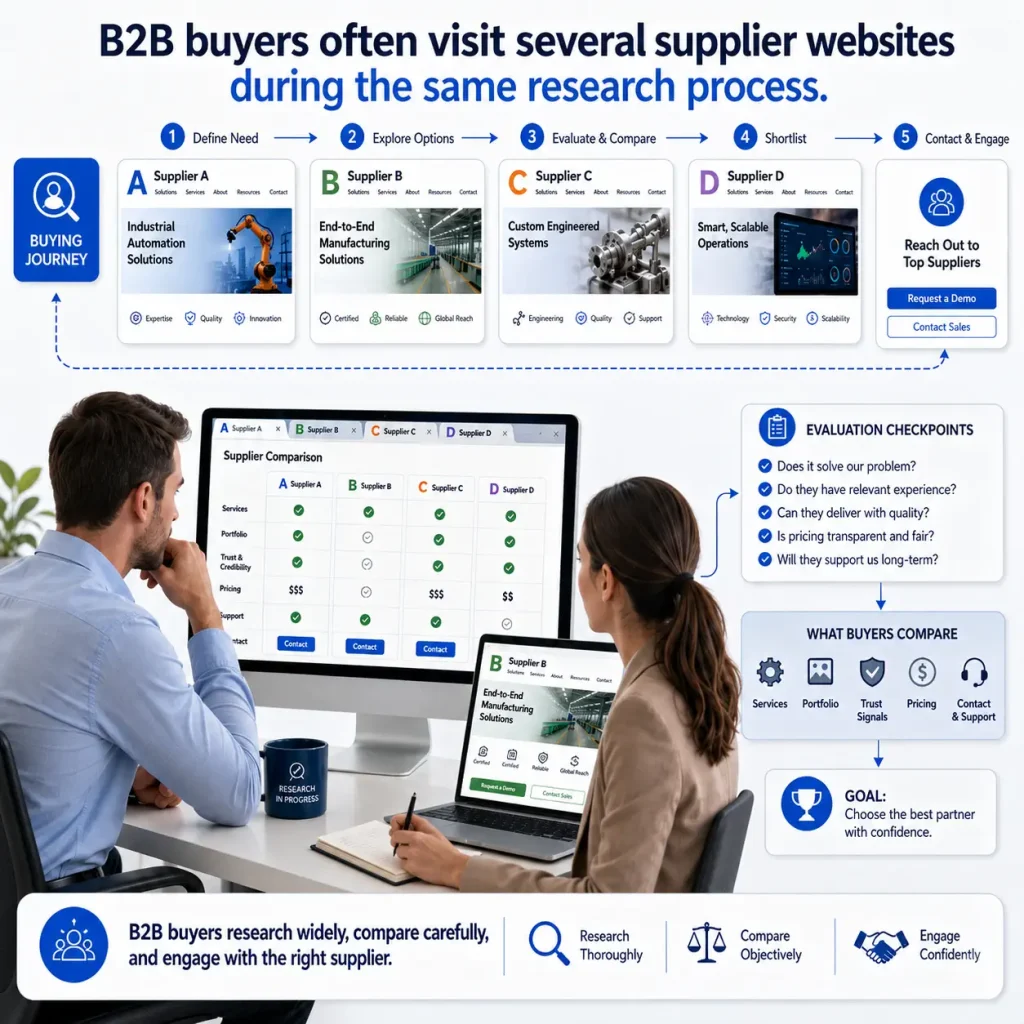
B2B buyers often visit several supplier websites during the same research process.
If your website makes them work too hard to understand your business, a competitor with a clearer message may move onto the shortlist first.
2. Does the Website Explain Business Outcomes, Not Only Services?
Many company websites describe what they provide:
Web Design
Engineering
Consulting
Software
Manufacturing
But buyers are also asking:
What will this help my company achieve?
Review whether your important pages explain outcomes such as:
- Improved operational efficiency
- Faster customer response
- Stronger corporate credibility
- Better lead generation
- Reduced manual work
- Improved customer experience
- Better visibility or market reach
Features explain what you sell.
Business outcomes help decision-makers understand why it matters.
3. Are Your Trust Signals Easy to Verify?
A B2B buyer should not need detective skills to confirm whether your company is credible.
Check whether your website clearly provides appropriate trust signals such as:
- Company name and business information
- Physical location where relevant
- Management or team information
- Client portfolio
- Case studies
- Industry experience
- Certifications or accreditations where applicable
- Recognisable client or partner relationships
- Current contact information
- Privacy policy and other relevant corporate information
The objective is not to fill the page with logos.
The objective is to reduce uncertainty.
4. Does Your Portfolio Show More Than Screenshots?
A portfolio should help a potential customer understand your experience.
Instead of showing only finished visuals, stronger B2B case studies may explain:
Client situation → Business requirement → Solution → Outcome
For example:
The client needed to restructure a corporate website before an IPO exercise. The project required clearer investor information, stronger corporate credibility, responsive presentation and an easier content management process.
Even when confidential information cannot be disclosed, context makes a portfolio more useful.
Pillar 2: Buyer Journey & Conversion
5. Does the Website Support Different Buyer Questions?
A first-time visitor and a procurement-ready buyer need different information.
Review whether your website helps visitors answer questions such as:
| Buyer Question | Useful Website Content |
|---|---|
| What does this company do? | Homepage / About |
| Can they solve our problem? | Service / Solution pages |
| Have they done something similar? | Case studies / Portfolio |
| Are they credible? | Company information / Clients / Credentials |
| How do they work? | Process |
| Is this suitable for our organisation? | Industry / Use-case pages |
| What happens next? | Enquiry / WhatsApp / Contact |
If everything leads immediately to “Contact Us”, the website may be asking for commitment before the buyer has enough confidence.
6. Are Your Services Organised Around Buyer Needs?
Avoid placing every capability into one long generic services page.
Where appropriate, important services should have dedicated pages explaining:
Who it is for
What problem it solves
What is included
How the process works
Relevant proof
Frequently asked questions
What to do next
This helps human buyers understand your company and gives search systems clearer information about individual services.
7. Is There Enough Proof Before the CTA?
Many websites repeatedly say:
Contact Us
Get a Quote
Talk to Us
without first answering the buyer’s main concern:
Why should I trust this company?
Before a major CTA, consider whether the visitor has seen enough relevant proof, such as:
- Relevant project experience
- Client examples
- Case studies
- Testimonials
- Company history
- Process transparency
- Relevant certifications
- Long-term support capability
A stronger website does not simply ask for enquiries.
It earns the right to ask.
8. Does the Website Offer a Clear Enquiry Path?
For Malaysian businesses, the enquiry journey may include both forms and WhatsApp.
Check whether visitors can easily:
- Submit a structured enquiry
- Contact the company through WhatsApp where appropriate
- Find the correct telephone or email contact
- Understand what information to prepare
- Know what happens after submitting an enquiry
For higher-value B2B projects, the enquiry process should also help qualify the opportunity.
Useful information may include:
Company name
Website URL
Service required
Business problem
Budget range
Timeline
The goal is not simply to generate more enquiries.
It is to make it easier for the right potential customers to start a useful conversation.
9. Is the Mobile Experience Suitable for Busy Decision-Makers?
B2B does not mean desktop-only.
A decision-maker may first view your website from a phone after receiving a WhatsApp message, LinkedIn post, email or referral.
Review:
- Navigation
- Text readability
- Tap targets
- Forms
- WhatsApp actions
- Tables
- Images
- Page speed
- Layout stability
A website that looks impressive on a large monitor but becomes difficult to use on mobile is only half designed.
Pillar 3: Technical Risk & Digital Governance
10. Is the Website Software Being Maintained Properly?
If your website uses a CMS such as WordPress, review whether your team has a controlled process for:
- CMS updates
- Plugin and theme updates
- PHP or server compatibility
- Testing before or after significant updates
- Removing unused components
- Monitoring security alerts
- Managing administrator accounts
Updates should not simply be installed blindly.
Important websites need an appropriate maintenance process that balances security, compatibility and business continuity.
11. Is the Hosting Environment Appropriate for the Business?
There is no single hosting architecture suitable for every organisation.
A small corporate website and a mission-critical customer platform may have very different requirements.
Review whether the current infrastructure is suitable for:
- Expected traffic
- Performance
- Security requirements
- Availability expectations
- Backup requirements
- Access control
- Scalability
- Support response expectations
The question is not simply:
“Is this shared hosting or cloud hosting?”
The better question is:
“Is the infrastructure appropriate for the risk and importance of this website?”
12. Are Security Controls Appropriate for the Website?
Depending on your website and risk profile, review areas such as:
- HTTPS configuration
- Modern TLS support
- Security headers where appropriate
- Administrator access control
- Multi-factor authentication
- Malware monitoring
- Firewall or WAF protection where required
- Form spam and bot protection
- Logging and monitoring
Security should be risk-based.
A simple marketing website and a portal containing sensitive customer data should not be treated as if they have identical security requirements.
13. Are Personal Data Collection Practices Being Reviewed?
If your website collects personal information through contact forms, registrations, applications, analytics or third-party systems, review whether the organisation has considered its applicable obligations under Malaysia’s Personal Data Protection Act (PDPA).
Review areas such as:
- What personal information is being collected?
- Why is the information required?
- Is appropriate privacy information provided?
- Which third-party platforms receive data?
- Who has access to submitted information?
- How long is information retained?
- Are forms protected appropriately?
- Are internal data-handling responsibilities clear?
Website design and data governance should not be treated as completely separate issues.
For organisations handling substantial or sensitive information, obtain appropriate legal, compliance and cybersecurity advice.
14. Can the Website Be Recovered if Something Goes Wrong?
A backup is useful only if it can actually be restored.
Review:
- Backup frequency
- Database backups
- Website file backups
- Offsite or independent backup copies
- Backup retention
- Restore testing
- Responsible person or vendor
- Recovery procedure
Different organisations may require different Recovery Time Objectives (RTO) and Recovery Point Objectives (RPO).
These should be based on business impact rather than an arbitrary universal target.
Pillar 4: SEO & AI-Assisted Search Visibility
15. Can Search Engines Clearly Access and Understand Your Important Content?
Google Search is increasingly incorporating generative AI experiences such as AI Overviews and AI Mode.
The fundamentals, however, remain familiar.
Important website information should still be:
- Publicly accessible where appropriate
- Crawlable
- Indexable
- Available as meaningful text
- Organised using clear headings
- Connected through useful internal links
- Supported by descriptive page titles
- Presented with a good user experience
Do not hide your most important service explanation inside graphics, videos or downloadable brochures only.
Search systems and human visitors should both be able to access the essential information directly on the page.
16. Does Each Important Page Have a Clear Purpose?
Review whether the title, H1 and main content tell a consistent story.
For example:
Page title: Corporate Website Design Malaysia
H1: Corporate Website Design for Malaysian Companies
Opening: Explain who the service is for, what business problem it addresses and what the visitor can expect.
Avoid vague pages trying to rank for ten unrelated services simultaneously.
Clarity helps both visitors and search systems understand what a page is about.
17. Are You Using Structured Data Appropriately?
Structured data can help search engines understand eligible information and may support certain Search features.
Depending on the page, appropriate structured data may include types such as:
Organization
Service
Article
BreadcrumbList
However, structured data is not a shortcut to rankings or AI recommendations.
It should accurately represent information already visible on the page and follow the relevant search engine guidelines.
18. Does Your Website Contain Real Expertise—or Only Generic Content?
AI has made producing generic articles extremely easy.
That makes genuine business experience more valuable.
Review your website content and ask:
Could almost any company or AI system have written this?
Stronger B2B content often contains:
- Real project observations
- Specific Malaysian market context
- Case studies
- Original frameworks
- Practical decision criteria
- Expert commentary
- Lessons learned from actual projects
- Clear author or company expertise
The goal is not to publish more articles.
The goal is to publish information worth finding.
Your B2B Website Audit Score
You can use a simple internal score:
| Result | Interpretation |
|---|---|
| Most checks pass | Website foundation is generally healthy; focus on optimisation |
| Several important gaps | Prioritise improvements based on commercial impact and risk |
| Major gaps across multiple pillars | A structured website review or revamp may be justified |
Do not redesign a website simply because it looks old.
A redesign should solve a business problem.
That problem might be:
Weak positioning
Low buyer trust
Poor enquiry flow
Outdated content architecture
Technical risk
Difficult maintenance
Poor mobile experience
Weak search visibility
Changed business strategy
Sometimes the right solution is a complete revamp.
Sometimes it is improving several high-impact areas without rebuilding everything.
Should You Revamp Your B2B Website?
Consider a deeper website review if your company has changed significantly but your website has not.
Typical triggers include:
- Your services or target market have changed
- The website no longer represents the quality of the company
- Sales teams rarely use the website during the sales process
- Prospects regularly ask questions that the website should already answer
- Enquiries are poor quality
- Marketing campaigns send visitors to weak landing pages
- Content is difficult for your internal team to maintain
- Important pages have poor search visibility
- Website technology is becoming difficult to support
- The website does not support your current corporate positioning
A Website Audit Should Lead to Priorities, Not a 100-Page Report
A useful website audit should not simply produce a long list of problems.
It should help management decide:
What should be fixed first?
What can wait?
What affects enquiries?
What affects trust?
What creates business risk?
What requires a redesign?
What can be improved without rebuilding the website?
That is where website strategy becomes more valuable than simply redesigning the interface.
Planning a B2B Website Review?
MWDesign helps Malaysian businesses review, redesign and improve business websites with a focus on clarity, buyer trust, conversion and long-term usability.
If your current website no longer supports where your business is heading, share your website URL, business objective, current challenge and expected timeline with us.
We can first determine whether the website needs a full revamp or whether targeted improvements would be more appropriate.
> Review Your Website with MWDesign now !!
If your website no longer supports your business positioning, buyer journey or enquiry goals, explore our business web design service.