What Is a Sales Page?
A sales page is a standalone, single-focused webpage designed with one specific objective: persuading a visitor to take a defined commercial action.
Unlike a standard informative page, every section on a sales page—from the headline down to the final call to action—is engineered to guide the reader through a logical decision-making process. Depending on your business model, that conversion goal might be purchasing a product, requesting a customized quotation, or booking a strategy consultation.
Sales Page vs Landing Page
While these terms are often used interchangeably, understanding their distinct strategic roles will change how you write your copy:
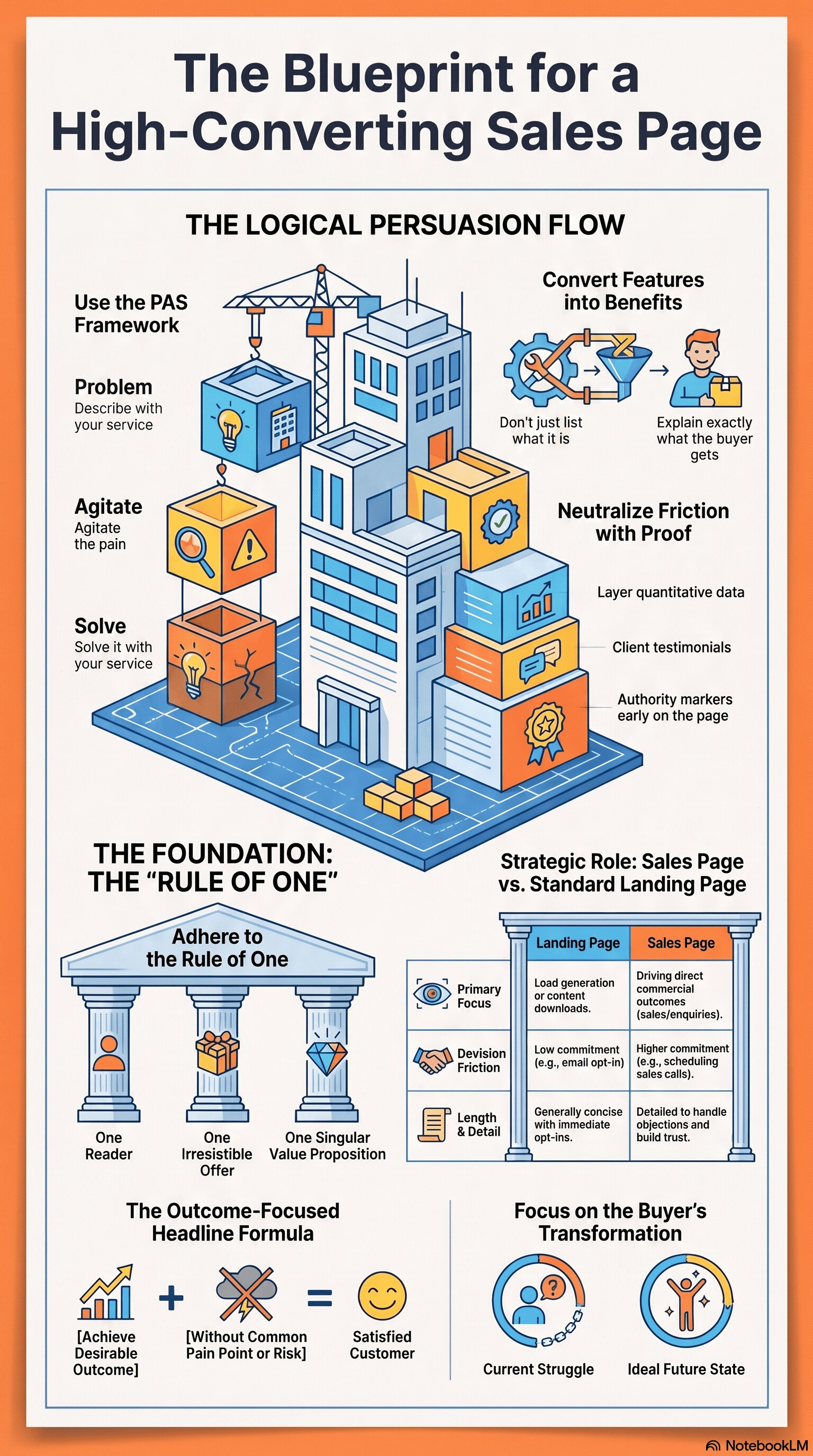
| Feature | Landing Page | Sales Page |
|---|---|---|
| Primary Focus | Lead generation, content downloads, event signups, or broad campaign targets. | Driving a direct commercial outcome (sale, quote request, enquiry). |
| Stage of Awareness | Often targets Problem-Aware or Solution-Aware visitors. | Targets Product-Aware or Most-Aware visitors ready to evaluate an offer. |
| Length & Detail | Generally concise with a single, immediate opt-in form. | Longer, detailed, and structured to handle objections and build deep trust. |
| Decision Friction | Low commitment (e.g., entering an email for a downloadable guide). | Higher commitment (e.g., spending budget or scheduling a sales call). |
Key Takeaway: Every sales page is a landing page, but not every landing page is a sales page. A sales page carries the heavy lifting of closing the gap between interest and commercial action.
Who Should Use a Sales Page?
A dedicated sales page is essential if you run:
- B2B Service Providers & Agencies: Offering high-value web design, consulting, corporate training, or logistics solutions.
- High-Ticket B2C Companies: Selling premium products or services requiring consumer education.
- Software & SaaS Providers: Looking to convert free trial users or website visitors into paying demo requests.
- Course Creators & Consultants: Selling specialized training programs or advisory packages.
If your current website receives visits but fails to generate qualified contact form submissions or WhatsApp enquiries, your primary offer requires a dedicated sales page structure.
Define One Audience and One Goal
The most effective sales copy adheres strictly to the Rule of One: write for one primary reader, presenting one irresistible offer, backed by one clear value proposition.
[ One Reader ] + [ One Offer ] + [ One Value Proposition ] = High Conversions
- Your One Reader: Identify the shared anxiety, goal, and pain point of your primary decision-maker.
(e.g., “The SME Owner whose web developer vanished, leaving them with a broken layout”). - Your One Offer: What specific step are you asking them to take today?
(e.g., “Request a 15-Minute Website Review”). - Your One Value Proposition: What is the singular, primary transformation or outcome they receive?
(e.g., “Turn your outdated website into a dependable enquiry engine”).
Attempting to speak to enterprise corporate buyers, budget shoppers, and job seekers on the same sales page dilutes your message and kills conversion rates.
Write an Outcome-Focused Headline
The sole job of your headline is to hook the reader and compel them to read the next line. Generic, feature-heavy headlines like “Professional B2B Web Design Services” fail because they tell the prospect what you do, rather than what they gain.
The Value Proposition Formula
[Achieve Desirable Outcome] + [Without Common Pain Point/Risk]
Weak Headline:
Expert Corporate Web Design Services in Malaysia
Strong Outcome Headline:
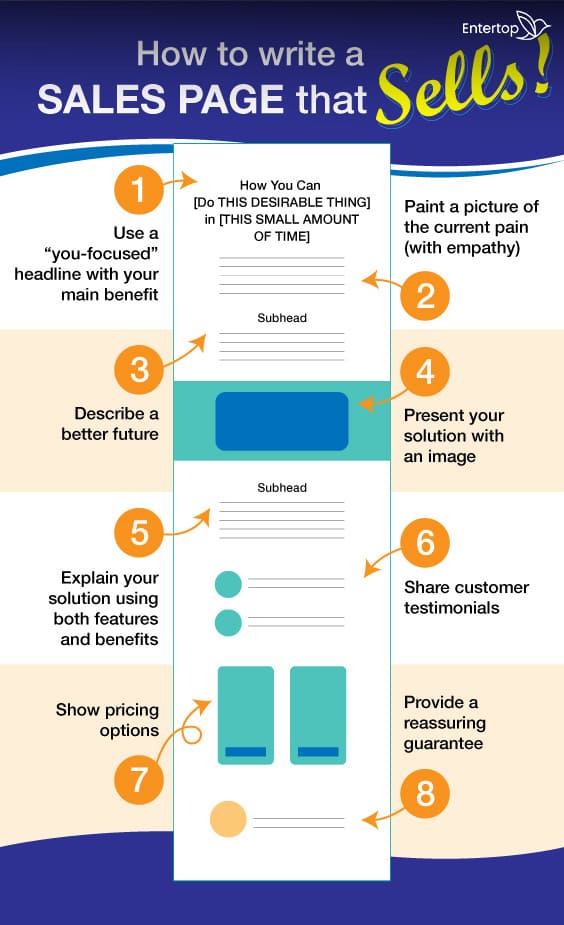
Turn Your Outdated Business Website into a 24/7 Enquiry Generator—Without Technical Headaches or Disappearing Developers.
Describe the Customer’s Problem
Before a prospect cares about your solution, they must feel that you thoroughly understand their current frustration. Use the Problem-Agitate-Solve (PAS) framework to mirror their exact experience back to them.
Describe the Reality:
“Your website looks presentable, but weeks pass without a single genuine sales lead.”
Agitate the Pain:
“Meanwhile, potential clients land on your mobile layout, encounter broken forms or misaligned images, and immediately leave to contact your direct competitor.”
When you articulate your customer’s pain point clearer than they can, they instantly attribute expertise and authority to your brand.
Present the Desired Outcome
Once the problem is clear, paint a vivid picture of the ideal future state. Shift the reader’s perspective from their current struggle to their desired business result.
“Imagine launching a website that actively earns client trust before your first sales call—where prospective buyers navigate smoothly, read your credentials, and submit enquiry forms without needing a hard sell.”
Focusing on the transformation helps prospects evaluate the true ROI of your offering.
Explain Your Solution Clearly
Introduce your product or service as the logical bridge between their current problem and their desired outcome.
Keep this section clear, direct, and structured. Avoid obscure industry jargon, buzzwords, or overly complex technical descriptions.
Example: “MWDesign redesigns corporate websites around customer clarity, strategic trust signals, and seamless conversion paths—ensuring your digital presence acts as a reliable, round-the-clock sales team.”
Convert Features into Benefits
Prospects rarely buy features; they buy what those features do for their business. Use the Feature-Advantages-Benefits (FAB) model to connect technical capabilities to concrete outcomes:
[ Feature: What it is ] ➔ [ Advantage: What it does ] ➔ [ Benefit: What they gain ]
| Feature (What it is) | Advantage (What it does) | Benefit (What the buyer gets) |
|---|---|---|
| Mobile-First Responsive Layout | Ensures flawless visual rendering across all smartphone screen sizes. | Stop losing mobile leads: Over 70% of B2B research happens on mobile. Capture prospective clients anywhere. |
| 360° Managed Maintenance | Provides ongoing security patches, technical fixes, and content updates. | Zero technical anxiety: Focus on running your operations while your digital assets remain secure, fast, and bug-free. |
Add Proof and Trust Signals
Trust is the single largest hurdle in online conversions. To validate your claims, layer proof throughout your sales page to satisfy both logical and emotional decision-makers:
- Quantitative Social Proof: Show hard numbers (e.g., “20+ Years of Experience | 900+ Websites Delivered”).
- Specific Client Testimonials: Highlight real results rather than generic praise.
- Authority Markers: Feature client logos, industry certifications, media coverage, and verified case studies.
High-Converting Testimonial Format
“The website redesign was completed in under two weeks. More importantly, our enquiry submission rate increased significantly within the first month.”
Address Objections and Risks
Every reader carries hesitation. Instead of hiding from potential objections, call them out directly and neutralize them:
Common B2B Objections & Risk Reducers
Objection: “What if our developer abandons the project halfway through?”
Fix: Highlight local support teams, clear contractual milestones, and ongoing maintenance SLA commitments.
Objection: “Will a redesign interrupt our ongoing operations?”
Fix: Guarantee zero site downtime and full SEO ranking preservation during migrations.
Note: For B2B and high-value services, replace gimmicky “money-back guarantees” with practical risk reducers: transparent scope of work, defined revision rounds, and dedicated post-launch support.
Explain Pricing or the Buying Process
Ambiguity creates hesitation. If your service involves custom scope pricing where exact figures cannot be listed on-page, clearly outline the exact buying process so the prospect knows what to expect next.
Our Transparent 4-Step Process
- Audit & Consultation: We analyze your existing site assets and outline strategic improvements.
- Structure & Copy Alignment: We organize your messaging around core customer motivations.
- Design & Engineering: We build custom, mobile-optimized layouts designed for clarity and speed.
- Launch & Support: We push your site live with ongoing technical maintenance and performance updates.
Write a Clear Call to Action
Your Call to Action (CTA) must tell the prospect exactly what step to take next and what happens after clicking.
Weak CTA:
Submit / Contact Us / Learn More
Strong Conversion CTA:
Request Your Free Website Audit or Talk to Our Technical Team on WhatsApp
[ Primary CTA Button: Request a Free Website Audit ]
[ Secondary CTA: View Recent Client Case Studies ]
Keep your primary CTA prominent, visual, and consistent throughout the page.
B2B vs E-Commerce Sales Pages
Tailor your copywriting layout based on your target business model:
| Comparison Factor | B2B Sales Page | E-Commerce Sales Page |
|---|---|---|
| Primary Conversion Goal | Qualified enquiries, sales calls, or formal quotation requests. | Direct online transaction/checkout. |
| Sales Cycle | Medium to long (involves multiple stakeholders). | Short to instantaneous (impulse or consumer buying). |
| Buyer Motivation | ROI, risk reduction, operational reliability, efficiency. | Personal utility, competitive pricing, emotional appeal, speed. |
| Urgency Strategy | Honest operational drivers (e.g., upcoming product launch, legacy system risks). | Scarcity tools (e.g., flash sales, limited stock counters). |
Sales Page Example
Here is a practical look at how these elements fit together on a live B2B service section:
Hero Headline:
Is Your Current Website Turning Away Potential Clients Before They Even Reach Out?
Sub-Headline:
We redesign outdated, glitchy business websites into high-converting lead generation engines for Malaysian SMEs.
Proof Bar:
Trusted by 900+ Businesses Across KL & Selangor | 20+ Years Experience
Primary Benefit Copy:
Stop wasting marketing spend on driving traffic to a leaky bucket. Our conversion-first web layouts guide prospective clients seamlessly from awareness to contact.
Call to Action:
[ Get Your Free Website Review ]
Common Sales Page Mistakes
Avoid these frequent copywriting pitfalls that undermine conversion rates:
- Trying to Be Too Snappy or Short: Sacrificing clear sales arguments for ultra-short, clever copy that fails to inform the prospect.
- Company-Focused “We” Statements: Writing extensively about your internal history rather than focusing on the customer’s problems and benefits.
- Multiple Competing CTAs: Asking the reader to watch a video, sign up for a newsletter, follow social media, and request a quote all on the same page.
- Hiding Social Proof at the Bottom: Burying client logos, metrics, and testimonials where fast-scanning decision-makers miss them.
Sales Page Checklist
Before publishing your page, verify every section against this conversion checklist:
☐ Headline: Does it clearly communicate a compelling customer outcome?
☐ Target Audience: Is it focused on one reader persona and their core anxiety?
☐ Pain Point: Did you articulate the customer’s problem before presenting your solution?
☐ Benefits: Are features explicitly connected to real business outcomes?
☐ Trust & Proof: Are metrics, client logos, or testimonials visible early on the page?
☐ Objection Handling: Have common buyer hesitations been called out and resolved?
☐ Single CTA: Is there one clear, action-oriented primary next step?
☐ Readability: Are headings, bold text, and bullet lists used to aid scannability?
Frequently Asked Questions
What is the ideal length for a sales page?
A sales page should be as long as necessary to answer your prospect’s questions and resolve their objections—and no longer. High-ticket or complex B2B offerings require longer, detailed copy to build trust, whereas familiar consumer products need less explanation.
How do I know if my sales page copy is working?
Track your conversion rate (the percentage of page visitors who complete your primary CTA form or WhatsApp action). If traffic is high but conversion is low, review your headline clarity, offer value proposition, and trust signals.
What is the single most important element on a sales page?
The headline. If your headline fails to hook the right audience and communicate immediate value, visitors will bounce before reading your remaining copy.
Turn Your Website into a High-Converting Enquiry Engine
Is your current website receiving visitors but failing to generate sales enquiries?
At MWDesign, we help Malaysian businesses plan, write, and engineer custom corporate websites designed around positioning, trust, and lead generation—not just appearance.
- Fix Broken Layouts & Mobile Issues: Ensure seamless user experiences across all devices.
- Local, Reliable Support: Never worry about unresponsive developers or missing support again.
- Conversion-First Architecture: Align your page structure directly with buyer decision-making modalities.
Ready to stop losing prospective clients to competitors?
Request a Free Website Conversion Audit with MWDesign