
Conversion rate is an important website metric. But it is not the only one that matters—and for some business websites, it may not even be the best primary measure of success.
An e-commerce website should help visitors complete purchases. A campaign landing page should generate leads. A booking website should turn visitors into appointments. In these cases, conversion is central to the website’s purpose.
However, many Malaysian business websites serve a longer and more complex buying journey.
A prospect may discover a company through Google, visit its website, review its services, check its portfolio, compare several providers, share the information with colleagues and only make contact days or weeks later. A procurement manager may use the website to verify whether a supplier belongs on a shortlist. An existing sales prospect may visit simply to confirm that the company appears credible enough to proceed.
These visits do not always produce an immediate form submission or WhatsApp message. That does not make them worthless.
The more useful question is not simply, “What is our website conversion rate?” It is:
What business decisions should our website help visitors make?
Once that purpose is clear, a company can measure the website more intelligently.
Why Conversion Rate Alone Can Give an Incomplete Picture
Website conversion rate normally measures the percentage of visitors who complete a desired action, such as:
- submitting an enquiry form;
- clicking a WhatsApp button;
- requesting a quotation;
- making a purchase;
- booking an appointment; or
- downloading a document.
These are useful signals. The problem begins when every website visit is treated as though it should result in an immediate action.
Business buyers rarely behave so neatly.
For a considered B2B purchase, the website may be only one part of the decision process. The person researching a supplier may not be the final decision-maker. They may need to present several options internally, confirm the budget or wait for management approval. Some prospects return through a direct visit, contact the company by phone, or approach a salesperson without mentioning the website at all.
A website can therefore influence a sale without receiving full credit for it in analytics.
This does not mean companies should ignore conversion data. It means they should interpret it within the actual customer journey.
The Four Jobs of a Business Website
Most effective business websites perform four connected jobs.
1. Help the right people find the company
The website should be technically accessible to search engines and structured around the questions potential customers ask. Search visibility helps a company enter the buyer’s consideration set.
Traffic alone, however, is not the goal. Attracting people who are unlikely to buy merely creates a larger number on a report. The better objective is relevant visibility among the markets, industries and decision-makers the business can serve well.
2. Help visitors understand the business
Within a short time, a visitor should be able to understand:
- what the company provides;
- who it serves;
- what problems it solves;
- why its offer is relevant; and
- where to find supporting information.
If the message is vague, a visually attractive website can still fail. Confused visitors rarely become confident buyers.
3. Build trust and reduce perceived risk
Before contacting a supplier, business buyers look for evidence. Depending on the company, this may include:
- relevant projects, portfolio work or case studies;
- customer names or testimonials;
- years of experience;
- accreditations, certifications or awards;
- a genuine office address and contact details;
- clear information about the team and process;
- current, accurate content; and
- a secure, professional and well-maintained website.
Trust is not merely a branding exercise. It reduces the buyer’s sense of risk. This is especially important when the project has a significant budget, affects business operations or requires a long-term vendor relationship.
4. Make the next step clear
Once a visitor understands and trusts the company, the website should offer an appropriate next step.
That may be a WhatsApp conversation, an enquiry form, a consultation request, a phone call, a product purchase or access to more detailed information.
The call to action should match the buyer’s readiness. A visitor researching a complex corporate service may not be ready to “Buy Now,” but may be willing to review a case study or discuss requirements.
The journey is therefore better understood as:
Find → Understand → Trust → Enquire
Conversion remains important, but it is supported by everything that comes before it.
Different Websites Need Different Definitions of Success
There is no universal scorecard for every website. The primary goal and supporting metrics should reflect the website’s role.
| Website type | Primary purpose | Useful indicators |
|---|---|---|
| E-commerce website | Generate online sales | Purchase conversion rate, revenue, cart abandonment, repeat purchases |
| Lead-generation website | Generate suitable enquiries | Qualified enquiries, cost per lead, WhatsApp/form completions, meeting rate |
| B2B corporate website | Build credibility and support evaluation | Qualified enquiries, return visits, key service-page engagement, case-study views, sales feedback |
| Professional services website | Demonstrate expertise and reduce risk | Consultation requests, article engagement, profile views, branded searches, lead quality |
| Manufacturer website | Explain capabilities and support sales | Product/capability-page visits, catalogue downloads, distributor or quotation enquiries |
| Recruitment website | Attract appropriate candidates | Job-page engagement, completed applications, candidate quality |
The lesson is straightforward: measure the behaviour that reflects the website’s intended business contribution.
A high conversion rate is not automatically good if most enquiries are irrelevant, outside the company’s budget range or only comparing the lowest price. A lower number of well-qualified enquiries may create far more commercial value.
Why “We Only Need a Simple Website” Is Often Misunderstood
Many businesses tell web designers that they only need a simple website. Wanting simplicity is sensible. Visitors should not struggle to understand or navigate a company website.
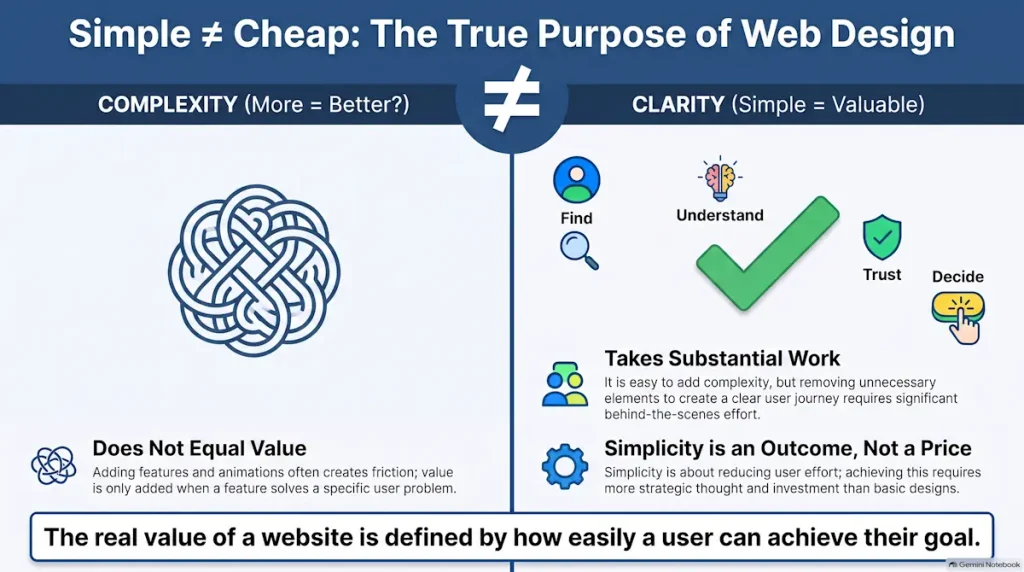
But simple does not mean cheap, and complex does not mean valuable.
Simplicity is an outcome for the user. Achieving it may require careful work behind the scenes:
- identifying the website’s real audience;
- prioritising the most important information;
- organising services into a logical structure;
- writing clear content;
- removing unnecessary choices;
- planning mobile navigation;
- designing useful calls to action;
- optimising speed, search visibility and accessibility; and
- testing whether visitors can find what they need.
A five-page website can be confusing if its message and structure are poorly planned. A much larger website can feel simple when its information architecture is clear.
The number of pages is not the best measure of simplicity. A better test is how easily the right visitor can understand the company and complete the next relevant task.
Simple is a design outcome. Cheap is a pricing decision.
More Features Do Not Automatically Create More Value
The opposite misconception is that adding more functions makes a website more valuable.
Animations, chatbots, calculators, member portals and integrations can be useful when they solve a genuine customer or operational problem. When they do not, they add cost, maintenance and distraction.
Before approving a feature, ask:
- What user or business problem does this solve?
- Who will use it?
- How often will it be used?
- What result should it improve?
- Who will maintain it after launch?
If there is no convincing answer, the feature may be decoration disguised as strategy. Technology is very good at creating impressive-looking problems for future maintenance teams.
How to Measure a Business Website More Effectively
A more balanced website review can use four groups of indicators.
Business outcomes
- Number of qualified enquiries
- Meetings or opportunities influenced by the website
- Proposal and close rates from website leads
- Revenue or pipeline influenced
- Reduction in unsuitable or price-only enquiries
Buyer behaviour
- Visits to high-intent service pages
- Portfolio and case-study engagement
- Return visits from prospects
- Branded searches
- Clicks to WhatsApp, email or telephone
Trust and clarity
- Whether prospects understand the offer before a sales call
- Questions repeatedly asked despite being covered—or not covered—on the website
- Feedback from customers and the sales team
- Engagement with company, process, certification and proof pages
Website health
- Search visibility for commercially relevant terms
- Mobile usability and page speed
- Form and tracking reliability
- Security, maintenance and uptime
- Accuracy and freshness of content
Not every company needs a complicated dashboard. A small set of metrics connected to the business goal is more useful than dozens of numbers nobody acts upon.
When a Low Conversion Rate Really Does Signal a Problem
The argument for a broader scorecard should not become an excuse for a website that fails to perform. Reviewing the right website trust signals can reveal why suitable prospects hesitate even when traffic appears healthy.
A low or declining conversion rate deserves investigation when:
- relevant traffic is increasing but enquiries are not;
- visitors reach important service pages but leave without taking another step;
- the offer is unclear or too generic;
- calls to action are difficult to find, especially on mobile;
- the site lacks portfolio work, case studies or other evidence;
- enquiry forms are too long or unreliable;
- page speed or usability creates friction; or
- many enquiries are poorly matched to the company’s preferred client profile.
In these cases, the solution is not always to add more buttons. The website may need clearer positioning, stronger proof, better content structure or a more appropriate conversion journey.
Questions to Ask Before Designing or Redesigning a Website
Before discussing colours, layouts or features, management and the web design team should answer:
- Who are the priority audiences?
- What brings each audience to the website?
- What should they understand before leaving?
- What concerns or risks may prevent them from contacting the company?
- What evidence will help them trust the business?
- What is the most appropriate next step for each audience?
- What would make an enquiry qualified rather than merely numerous?
- How will the website support sales after the enquiry?
- Which results will be reviewed after launch?
These questions shape the content, navigation, proof, calls to action and measurement plan. Without them, a redesign can easily become a visual update that leaves the underlying business problems untouched.
Frequently Asked Questions
What is a good conversion rate for a business website?
There is no universal benchmark that applies to every business. Conversion rates vary by industry, traffic source, offer, purchase complexity and the action being measured. Compare performance against your own baseline and, more importantly, assess the quality and commercial value of the resulting enquiries.
Should a corporate website focus on branding or lead generation?
Usually both, but the balance depends on the company. Corporate branding builds the trust required for an enquiry, while lead-generation elements make the next step clear. They should support each other rather than be treated as competing goals.
Can a website be successful without generating direct enquiries?
Yes, if its defined role is to support sales, validate credibility, inform partners, attract candidates or assist another measurable business process. However, the company should still define evidence that shows whether the website is performing that role.
Does adding more calls to action improve conversion?
Not necessarily. More buttons cannot compensate for an unclear offer or lack of trust. The best call to action is relevant, easy to find and appropriate to the visitor’s stage in the buying journey.
When should a company consider redesigning its website?
Consider a redesign when the website no longer reflects the business, confuses priority customers, looks less credible than the company it represents, attracts the wrong enquiries, performs poorly on mobile or cannot support current marketing and sales needs. A structured website revamp or redesign should address these business issues rather than only replace the visual style.
Design the Website Around Its Business Purpose
Conversion rate matters, but it should not be used in isolation.
A good business website helps the right people find the company, understand its offer, trust its capabilities and take an appropriate next step. Sometimes that journey produces an enquiry during the first visit. Sometimes the website supports a decision that becomes visible only later.
The goal is not to avoid measurement. It is to measure what genuinely matters.
Before asking how many pages or features a new website should have, begin with a more strategic question:
What should this website help the business—and its customers—decide or achieve?
When the answer is clear, design becomes more focused, content becomes more useful and conversion becomes the result of a stronger overall experience.
If your current website no longer supports your positioning, sales process or preferred customers, talk to MWDesign about a website review. We help Malaysian businesses plan and build websites around clear business goals—not just a new visual appearance.